
Maya Sialuk Koch Madsen
Traditional Practice, Contemporary Communties

Taking inspiration from the centuries of Inuit tattooing that came before her, Maya Sialuk Koch Madsen’s practice revolves around embodied and self-determined identity. Living in Denmark as an Inuit person, Sialuk Koch Madsen is closely familiar with cultural assimilation as well as its rejection. Beginning our conversation, Sialuk Koch Madsen specified to me that Inuit tattooing, at its core, is a spiritual practice – neither a collection of trendy markings nor a written language. The dots and lines commonly seen in this tradition cannot be reoriented to cater to a particular client’s desires; rather, they indicate collectivity and community. Sialuk Koch Madsen provided the example of a woman requesting a tattoo representative of her motherhood and love for nature. No Inuit design contains such a meaning – creating one would thus separate this design from the traditional practice it stems from.
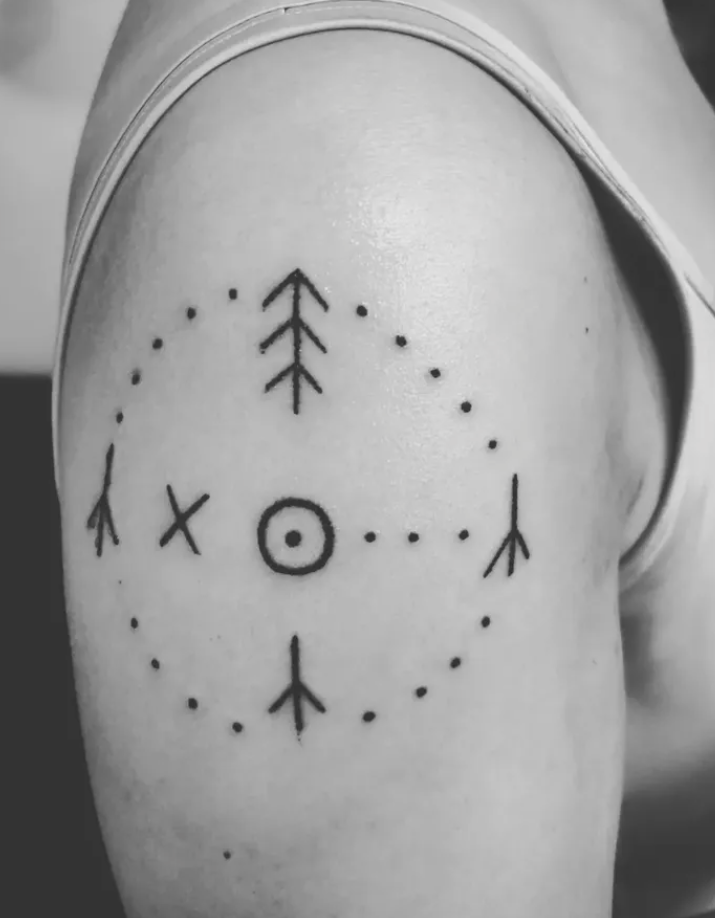
“Individualism is the biggest threat to our original culture. And yet it is something we cannot avoid because we become more and more Western.”
This tradition spans thousands of years and differs based on locality. In Eastern parts of Inuit land, tattooing is often amuletic, marking tribal affiliation or protection against hurt during the hunt or from spirits. Meanwhile, Western areas use tattooing to describe what has already happened. Mindsets concerning tattoos’ purpose differ widely across these regions, but Sialuk Koch Madsen emphasized that Inuit tattooing online only represents Eastern styles. The internet’s widespread use has expanded Inuit tattooing from the traditional eleven to fifteen designs to over eighty. Sialuk Koch Madsen centers her practice around traditional amuletic tattooing in order to honor the generations of tattooed Inuit women who came before her.
Sialuk Koch Madsen’s work falls into the realm of revitalization, or the effort to reclaim a cultural practice or identity. The framework of colonial Christianity, pushing for individual exceptionalism, negates the Inuit spiritual necessity for tattooing. However, Sialuk Koch Madsen allows for tradition to reintegrate into contemporary community by encouraging cultural education and understanding. Interestingly, most of Sialuk Koch Madsen’s clients did not grow up in an Inuit community or have only one Inuit parent. Receiving culturally significant tattoos, according to the artist, allows these individuals to feel comfortable claiming their indigeneity (or to “prove” it to others). Meanwhile, Inuit people living in rural, remote areas of Greenland have neither the time, resources, nor interest in displaying their heritage on their skin. According to Sialuk Koch Madsen, unlike diasporic communities with blond hair or light skin, Greenlandic populations usually don’t feel the need for ancestral tattoos to create a connection between their bodies and their Indigenous ancestors.
Though research on Inuit tattooing often includes a focus on subdermal techniques (otherwise inaccurately named as “skin stitching”), Sialuk Koch Madsen says very few clients request subdermal tattoos. Instead, she primarily works with handpoke. In research alongside Aaron Deter-Wolf and other tattoo archaeologists, Sialuk Koch Madsen takes a more anthropological approach. Interested in spirituality, religion, and patterns, her research informs the more immaterial aspects of tattooing. Continuing her multidisciplinary studies surrounding Inuit culture and tattooing, Sialuk Koch Madsen hopes to more widely inform the public about such practices through anthropological research and hands-on tattooing.